数字单兵
煤炭科学研究总院矿山单兵装备智能化技术团队针对我国矿山行业长期存在的职业健康防护薄弱环节与单兵装备智能化程度低等问题,以提升矿工生命安全与作业效能为核心目标,通过系统性技术创新与跨学科融合攻关,成功研发出国内首套面向煤矿工人职业健康防护与智能穿戴需求的整体解决方案。该系列成果围绕矿山作业环境中粉尘浓度高、有害气体聚集、复杂地形限制、人机交互低效等痛点问题展开深度研发,构建了覆盖呼吸防护、环境感知、智能交互、应急保障等多维度的技术体系,标志着我国矿山安全装备从传统被动防护向主动智能防护的跨越式升级。
在职业健康防护领域,团队突破传统防护装备功能单一、舒适性差的局限,创新性提出"主动防御+动态净化"技术路径,自主研发的矿用单兵正压防护系统通过空气动力学仿真与人体工程学优化,构建了分级过滤与智能风量调节相结合的多级防护机制。在保证高效呼吸防护性能的同时,创造性基于呼吸流场仿真角度进行大幅优化,显著提升长时间佩戴的舒适性。
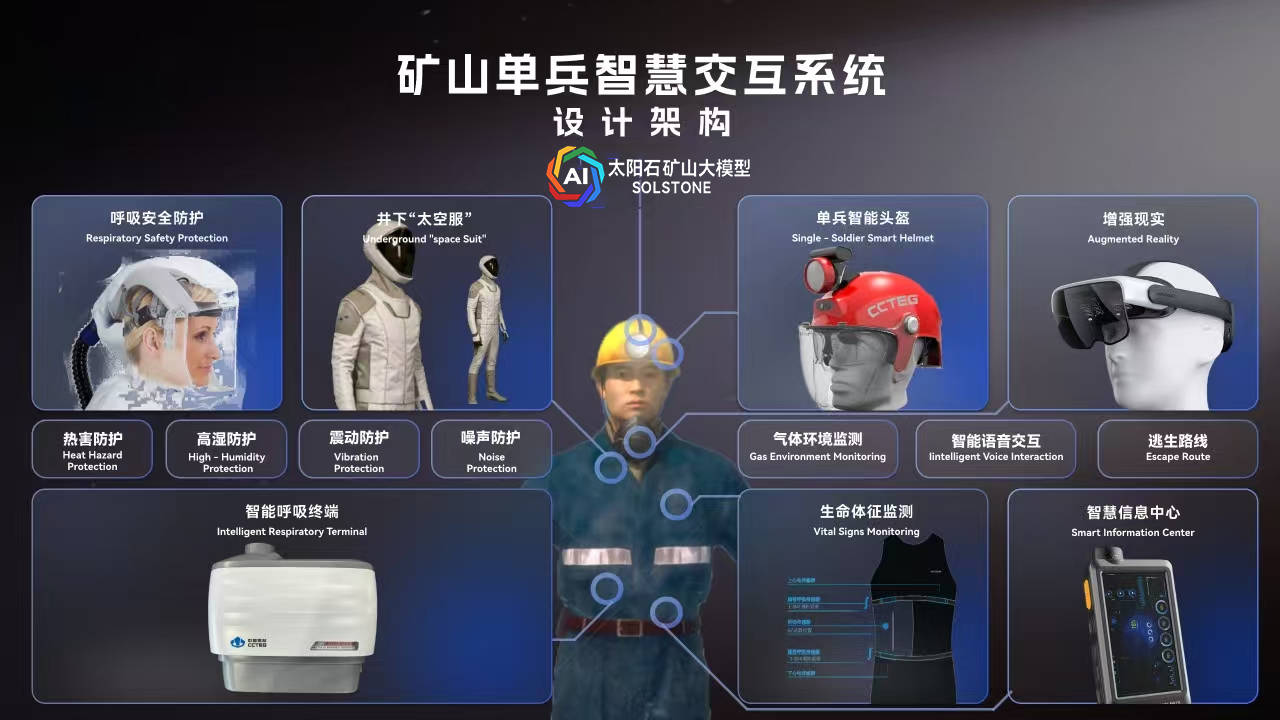
在智能感知与交互技术层面,团队构建了分布式智能单兵装备系统架构,通过边缘计算与云端协同的技术路线,实现了装备系统的模块化扩展与自适应组网能力。创新研发的增强现实显示系统突破井下复杂光照环境限制,采用低功耗微投影技术与光波导显示方案,将设备运行状态、逃生路线指引等关键数据以全息影像形式叠加于真实视野。双向骨传导语音系统通过振动传感器与降噪算法的深度优化,在井下高噪声环境下仍能保持清晰语音通信。
通过深度整合物联网与人工智能技术,团队开发了矿用井下人联网系统平台,通过异构数据融合引擎实现对人员定位、生命体征、环境参数、设备状态等多元信息的实时解析与智能联动。通过分布式定位算法结合惯性导航与超宽带技术,配合三维数字孪生地图可实现动态路径规划与风险预警。生命体征监测模块采用柔性电子织物技术,持续采集心电、体温、运动状态等生理数据,通过机器学习模型建立个体健康基线,对疲劳状态、热应激反应等职业健康风险进行早期预警。装备还创新集成设备交互控制功能,通过近场无线通讯协议实现与采煤机、掘进机等大型设备的智能互联,作业人员可在安全距离外完成设备状态监控与关键操作,大幅降低近距离作业风险。
该系列技术成果的推广应用从根本上改变了传统矿山安全防护装备的被动防御模式,构建了"智能感知-主动防护-协同决策-动态优化"的闭环防护体系。经井下工业性试验验证,系统可有效防护高粉尘环境造成的职业健康风险,突发事故应急响应效率有效提升,同时复杂工况下的作业效率显著提高,为矿山行业数字化转型提供了关键装备支撑。其技术突破不仅体现在硬件层面的创新,更在于构建了覆盖装备研发、数据中台、智能算法的完整技术生态,形成了可复制推广的智能单兵装备技术标准体系。此项研发成果的产业化应用将有力推动我国矿山安全装备从跟跑向并跑、领跑的转变,为践行"以人为本"的安全发展理念提供了科技范本,对促进矿山行业智能化转型升级、构建新型矿山安全保障体系具有里程碑意义,标志着我国在矿山智能穿戴装备领域已达到国际领先水平,为全球矿山安全防护技术发展贡献了中国方案。
China Coal Research Institute Mine Individual Equipment Intelligent Technology Team has addressed long-standing weaknesses in occupational health protection and the low level of intelligence in individual equipment within China's mining industry. With the core objective of enhancing miners' safety and work efficiency, the team successfully developed China's first integrated solution for coal miners' occupational health protection and intelligent wearable needs through systematic technological innovation and interdisciplinary collaboration. These achievements target key challenges in mining environments, such as high dust concentration, hazardous gas accumulation, complex terrain limitations, and inefficient human-machine interaction. They establish a comprehensive technological system covering respiratory protection, environmental perception, intelligent interaction, and emergency support, marking a leap in China's mine safety equipment from traditional passive protection to active intelligent protection.
In the field of occupational health protection, the team broke through the limitations of traditional protective equipment, such as single functionality and poor comfort. They innovatively proposed a technical path of "active defense + dynamic purification." The self-developed mine individual positive pressure protection system utilizes aerodynamic simulation and ergonomic optimization to create a multi-level protection mechanism combining graded filtration and intelligent airflow regulation. While ensuring high-efficiency respiratory protection, it significantly improves wearing comfort over long periods through substantial optimization based on respiratory flow field simulation.
At the level of intelligent perception and interaction technology, the team established a distributed intelligent individual equipment system architecture. Through an edge computing and cloud collaboration approach, they achieved modular expansion and self-adaptive networking capabilities for the equipment system. The core device, the intelligent helmet, integrates a miniature environmental monitoring array that can detect real-time concentrations of key gases like methane, carbon monoxide, and oxygen in the work area. Combined with environmental parameters such as temperature, humidity, and air pressure, it builds a multi-dimensional safety assessment model. When abnormal data is detected, it automatically triggers audible and visual alarms and initiates emergency protection protocols. The innovatively developed augmented reality display system overcomes the limitations of complex underground lighting environments by using low-power micro-projection technology and an optical waveguide display solution, superimposing key data such as geological structure information, equipment operational status, and escape route guidance onto the real field of view as holographic images. The bidirectional bone conduction audio system, through deep optimization of vibration sensors and noise cancellation algorithms, maintains clear voice communication even in high-noise underground environments.
By deeply integrating Internet of Things (IoT) and artificial intelligence (AI) technologies, the team developed a Mine Underground Personnel Networking System platform. Using a heterogeneous data fusion engine, it enables real-time parsing and intelligent linkage of diverse information including personnel positioning, vital signs, environmental parameters, and equipment status. Through distributed positioning algorithms combining inertial navigation and ultra-wideband (UWB) technology, coupled with 3D digital twin maps, it enables dynamic path planning and risk early warning. The vital signs monitoring module uses flexible e-textile technology to continuously collect physiological data such as ECG, body temperature, and motion status. Machine learning models establish individual health baselines for early warning of occupational health risks like fatigue state and heat stress response. The equipment also innovatively integrates device interaction control functions, enabling intelligent interconnection with large equipment like shearers and roadheaders through near-field wireless communication protocols. This allows operators to monitor equipment status and perform key operations from a safe distance, significantly reducing the risks associated with close-range work.
The promotion and application of these technological achievements fundamentally transform the traditional passive defense mode of mine safety protection equipment, establishing a closed-loop protection system of "intelligent perception - active protection - collaborative decision-making - dynamic optimization." Verified through underground industrial trials, the system can effectively protect against occupational health risks caused by high-dust environments, significantly improve emergency response efficiency for sudden incidents, and markedly enhance operational efficiency in complex working conditions. It provides crucial equipment support for the digital transformation of the mining industry. The technological breakthroughs are manifested not only in hardware innovations but also in building a complete technological ecosystem covering equipment R&D, data middleware, and intelligent algorithms, forming a replicable and promotable standard system for intelligent individual equipment technology. The industrialization of this R&D achievement will powerfully propel China's mine safety equipment from following to running neck-and-neck, and then to leading the way. It provides a technological paradigm for practicing the "people-oriented" safety development concept, holds milestone significance for promoting the intelligent transformation and upgrading of the mining industry and building a new mine safety assurance system, marks that China has reached internationally leading levels in the field of mine intelligent wearable equipment, and contributes Chinese solutions to the development of global mine safety protection technology.
长按二维码【关注公众号】,获取更多精彩内容!

煤科总院
联系人:张亦凡 联系电话:15210565436